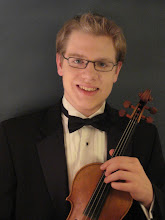


I had a very exciting experience last night, because I was given the opportunity to premier my very own, personally-written violin concerto! (Only movement I since the other movements aren't finished yet.) I composed the piece for full orchestra and solo violin surrounding last summer, and this year I showed it to one of my conductors who is also a composer and he told me to arrange it for string orchestra so we could play it! Last year the same orchestra played a movement of my symphony, which was fun, but I learned from composing and playing that symphony and I feel like this piece had many improvements. For one, the structure was much more, well, structured! Plus, everything flowed together much better on this piece. Everyone seemed to really enjoy it, and it got a standing ovation from the audience. The only sad part was I only had 2 or 3 weeks to learn the solo part myself, and let's just say I am not a very nice composer...that thing is HARD! I think I pulled it off enough to make it work though, and the orchestra sounded great!
For any composers out there (who I doubt would be wasting their time reading this), do whatever you can to get your stuff played, even if it's just a bunch of amateurs or younger musicians or whoever! If they're willing to play it, you can learn a lot from the experience. It really helps you find out what works and what doesn't. Even if you are completely certain that a certain idea will turn out some way, you would be surprised how different it can sound in real life than on a midi player or in your head. Sometimes it's better, sometimes it's worse. In my case, I think it was much better, and now I have a decent recording of it (which will also be useful in the future).
Now that I've edited it for string orchestra (and timpani) and solo violin, I'm wondering if I want to keep that orchestration. I kind of liked it...maybe I'll write it as both! Then I have to do the piano edition, and, and, and...this composition stuff has so much busy-work involved! But it's fun when I have time for it...
...and for all you NON-composers out there (who I also doubt would be wasting their time reading this), give it a shot. Even if it's just a simple melody, or a chord progression, it can be enlightening to put yourself in the seat of a composer. It gives you much more insight into what kind of methods composers might be using, and therefore gives you a better idea on the thoughts of composers. Personally, I think this has improved my ideas on music greatly. So go out there and write a masterpiece, keeping in mind that twinkle twinkle little star could be argued to be one of Mozart's greatest masterpieces!
-Phil
Showing posts with label symphony. Show all posts
Showing posts with label symphony. Show all posts
Friday, May 13, 2011

Sunday, January 17, 2010
Ch ch ch ch ch ch ch ch ch ch ch ch ch
It's all about internal rhythm. Especially when it comes to Saint-Saens Organ Symphony No. 3 in C minor, or as my stand partner has re-labeled it, Saint-Saens Organ Symphony No. 8 in O minor. Yep, that's the kinda fun I have in orchestra :P
But speaking seriously, if you've ever heard/played the organ symphony, you know the challenge of bringing all the parts to the same downbeat without hardly any of them actually playing the downbeat. All of the off-beats and strange rhythms can so easily throw any of us off, and if only one person is thrown off the entire orchestra will most likely slowly (or not so slowly) adjust to that one person. Therefore, it's all about the internal beat. Today during orchestra rehearsal, our conductor had us playing all sorts of "games," such as playing our notes on beats 1, 2, 4, and 5 and saying "3" and "6" when we have rests on these beats, all going at a fairly upbeat tempo. He also had the entire orchestra create this "ch ch ch ch ch ch" sound together. At the same time he asked those who have birthdays in certain months to raise there hands, and other similar questions. This caused us to be thinking about something else as we continued the beat. In the end, it's a kind of rub your belly/pat your head exercise. If you think about it, we need to be doing the exact same thing while we're playing. Keep an beat going steadily internally while playing your instrument...it sounds easy but is so, so hard.
Still it's an interesting exercise, and afterwards we did sound better (although far from perfect). Perhaps there are even more ways to expand on this exercise. It's definitely something to ponder...
-Phil
But speaking seriously, if you've ever heard/played the organ symphony, you know the challenge of bringing all the parts to the same downbeat without hardly any of them actually playing the downbeat. All of the off-beats and strange rhythms can so easily throw any of us off, and if only one person is thrown off the entire orchestra will most likely slowly (or not so slowly) adjust to that one person. Therefore, it's all about the internal beat. Today during orchestra rehearsal, our conductor had us playing all sorts of "games," such as playing our notes on beats 1, 2, 4, and 5 and saying "3" and "6" when we have rests on these beats, all going at a fairly upbeat tempo. He also had the entire orchestra create this "ch ch ch ch ch ch" sound together. At the same time he asked those who have birthdays in certain months to raise there hands, and other similar questions. This caused us to be thinking about something else as we continued the beat. In the end, it's a kind of rub your belly/pat your head exercise. If you think about it, we need to be doing the exact same thing while we're playing. Keep an beat going steadily internally while playing your instrument...it sounds easy but is so, so hard.
Still it's an interesting exercise, and afterwards we did sound better (although far from perfect). Perhaps there are even more ways to expand on this exercise. It's definitely something to ponder...
-Phil
Friday, January 15, 2010
Daugherty vs. Golijov
If you haven't heard the music of either Michael Daugherty (modern composer and composition teacher at Michigan State University) or Osvaldo Golijov, then you need to. Now. In my opinion, these are two of the greatest living composers out there, and surprisingly - even though their backgrounds are completely different - they seem to have very similar styles of writing. Both flourish using a strong cultural influence, even though the cultures are very different.
Daugherty, who grew up in Iowa, has a strong jazz background, and often uses American cultural icons as inspiration for his pieces. For example, his best-known work, Metropolis Symphony, is a symphony of 5 movements, each one based on a character from the Superman epic. On the other hand, Osvaldo Golijov grew up in an Eastern European Jewish household. In his later years as a composer, both his religious background and cultural background would have great influences on his music.
Both are very unique composers, yet at the same time share certain qualities. Recently, I played a piece called Strut by Daugherty, and several of my friends whom I had played a piece called Last Round by Golijov, and both they and I recognized the similarities between them. It's a very odd coincidence when two composers with completely different backgrounds who have (probably) never met can sound so similar but they do. Seriously, go look them up. Even if you don't agree with me, I'll still have gotten you to listen to two extremely talented modern composers.
-Phil
Daugherty, who grew up in Iowa, has a strong jazz background, and often uses American cultural icons as inspiration for his pieces. For example, his best-known work, Metropolis Symphony, is a symphony of 5 movements, each one based on a character from the Superman epic. On the other hand, Osvaldo Golijov grew up in an Eastern European Jewish household. In his later years as a composer, both his religious background and cultural background would have great influences on his music.
Both are very unique composers, yet at the same time share certain qualities. Recently, I played a piece called Strut by Daugherty, and several of my friends whom I had played a piece called Last Round by Golijov, and both they and I recognized the similarities between them. It's a very odd coincidence when two composers with completely different backgrounds who have (probably) never met can sound so similar but they do. Seriously, go look them up. Even if you don't agree with me, I'll still have gotten you to listen to two extremely talented modern composers.
-Phil
Subscribe to:
Posts (Atom)